

How to Transition from Program Manager or Product Owner to Forward Deployed AI Engineer
 Yahya Bandukwala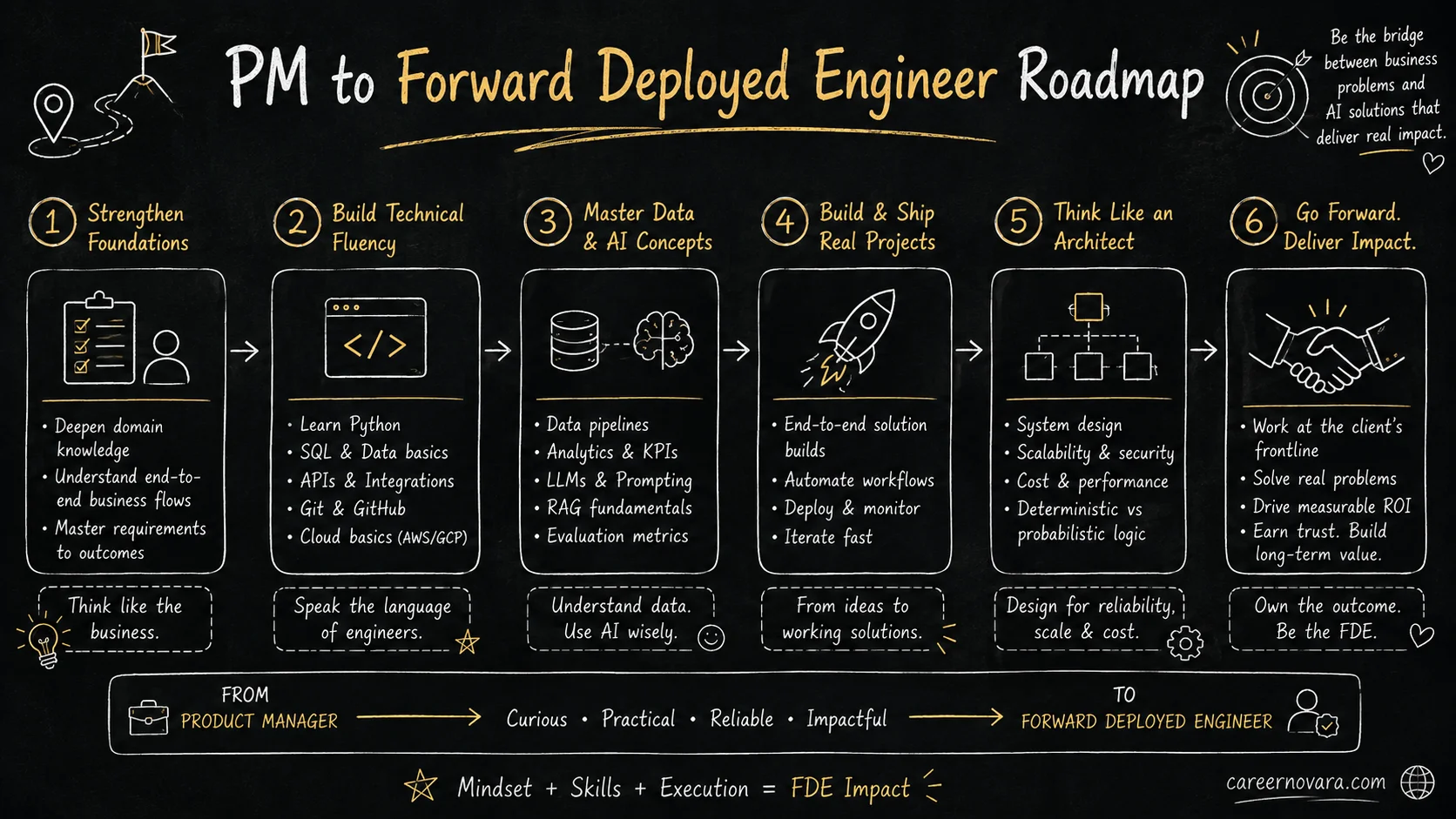
Key Takeaways
Instant Summary- The Forward Deployed Engineer (FDE) role combines customer discovery, system architecture, and practical AI execution into a single high-impact career path.
- Program Managers and Product Owners already possess 50 percent of the required FDE skill set: customer empathy, scope definition, and stakeholder management.
- By learning rapid AI prototyping tools and basic system integration rules, PMs can transition into FDE roles without an advanced computer science degree.
If you are currently working as a Program Manager, Product Owner, or Business Analyst, you may have noticed a shift across the technology industry. Companies like Palantir, OpenAI, Scale AI, and major enterprise consultancies are aggressively hiring for a role called the Forward Deployed Engineer (FDE).
(In my own experience leading engineering divisions across global organizations, I watched traditional role boundaries slowly collapse. The professionals who thrived were not those who stayed isolated in project management tools, but those who stepped closer to customer systems and built real solutions.)
The market is moving away from isolated management roles where one person writes tickets and another writes code. Industry reports on TechCrunch and Forbes highlight that enterprises now prefer embedded engineers who can understand client needs and deploy working software on the spot.
If you are aiming for a successful transition to forward deployed engineer, your background in program or product management is actually a massive advantage. You do not need to restart your career from scratch.
Here is a practical, step-by-step roadmap to bridge your management background into a high-impact FDE role.
Why Program Managers and Product Owners Have an Unfair Advantage
Many product managers assume that transitioning into an engineering role requires years of studying algorithms or mathematical theory. That belief is false.
An FDE is essentially three roles combined into one: a consultant who understands client pain points, a product manager who defines boundaries, and a practical builder who deploys software.
(When managing complex technical rollouts, the hardest part was almost never the coding logic. The real bottleneck was getting developers to understand what the customer actually needed. As a PM, you already know how to solve that bottleneck.)
You already master customer discovery, requirement gathering, and stakeholder communication. Your main goal is simply adding practical AI execution skills to your existing strength.
Do not throw away your product management background. Your ability to translate messy customer problems into clear requirements is 50 percent of the FDE role.
Step 1: Shift from Writing Specs to Building Prototypes
Traditional product owners write long specification documents and hand them off to engineering teams. Forward Deployed Engineers build working prototypes to validate ideas immediately.
With modern AI coding assistants like Claude Code and GitHub Copilot, you do not need to memorize syntax. You can use your clear problem framing skills to prompt AI assistants into generating frontend UIs and backend logic.
(I often tell mentees that modern vibe coding is simply high-precision product management. If you can write a detailed user story, you can prompt an AI assistant to build a functional prototype.)
- Action Item: Pick a routine manual workflow in your current team. Use an AI coding tool to build a simple web prototype that solves it in under 48 hours.
Step 2: Master System Integration and API Boundaries
As an FDE embedded at a customer site, you will rarely build systems from complete scratch. Instead, you will connect client databases, legacy APIs, and enterprise cloud infrastructure to AI models.
You need to understand how web APIs transfer data, how authentication works, and how to define JSON schemas.
- REST APIs and JSON: Learn how data moves between systems using GET and POST requests.
- Deterministic Logic vs. AI Outputs: Never rely on AI for business rules or math calculations. Use traditional code for rules and AI only for parsing unstructured text.
Enterprise clients care about reliability. Keep business logic and security checks in traditional code, and use AI models strictly for unstructured data processing.
Step 3: Learn Eval Engineering (Testing AI Quality)
In traditional software, code either works or throws an error. Large Language Models are probabilistic, which means they can give slightly different answers each time.
Product owners who transition to FDE roles excel at Eval Engineering. This means creating test datasets and scoring systems to evaluate whether AI responses are accurate, safe, and helpful for end users.
(In my experience overseeing product quality, defining what good looks like is a core management responsibility. Setting up AI evaluation metrics is simply applying product acceptance criteria to model outputs.)
- Action Item: Create a spreadsheet of 50 real customer inquiries and benchmark how accurately your AI pipeline answers them under different prompt variations.
Step 4: Map Your Career Transition Path
To make the career transition seamless, align your current skills with the technical capabilities required for an FDE role:
| Skill Dimension | Product Manager / Owner Baseline | Target FDE Execution Capability | Bridge Skill to Learn |
|---|---|---|---|
| Problem Scoping | Writes PRDs and user stories | Defines hard API schemas and boundaries | JSON Schema & OpenAPI specs |
| Development | Manages sprint backlogs | Builds rapid AI prototypes | AI coding assistants (Claude Code) |
| Quality Assurance | Conducts User Acceptance Testing | Designs automated AI evals | Evaluation frameworks (RAG Evals) |
| Deployment | Coordinates launch schedules | Deploys containers to cloud servers | Docker & basic cloud hosting |
Step 5: Build a Portfolio of Embedded Solutions
Hiring managers at AI companies value proof of execution far more than degrees or certifications.
To demonstrate your readiness for an FDE role, build 2 or 3 small end-to-end projects. Document the customer problem, show the architecture diagram, share the working code repository, and record a 2-minute video walkthrough.
(When interviewing candidates for senior technical roles, a candidate who presents a working solution that solved a real workplace issue immediately stands out from fifty resumes listing certifications.)
Summary and Next Steps
Transitioning from a Program Manager or Product Owner into a Forward Deployed Engineer is one of the most rewarding career upgrades in today’s market. You combine your strategic business instincts with hands-on AI deployment capability.
(Stop overthinking whether you have enough technical background. Start by picking one business problem and building your first AI prototype this week.)
Elevate Your Career with CareerNovara
At CareerNovara, we provide practical training and 1:1 mentorship for engineers, product managers, and working professionals:
- 1:1 AI Career Coaching: Get customized prompt engineering tools and resume positioning guidance at /coaching.
- AI Productivity Bootcamp: Master zero-coding workplace AI tools in our 11-day cohort at /bootcamp.
- 1:1 Strategic Mentorship: Work 1:1 with Yahya Bandukwala to architect your career transition at /mentorship.
- Chat on WhatsApp to discuss 1:1 career coaching.
Benchmark Your Forward Deployed Engineer Readiness
Taking your next career leap into AI & Field Engineering? Evaluate your 3-pillar capabilities across business strategy, system bounds, and execution in 5 minutes.