

The 5 Non-Negotiable Skills Every Forward Deployed Engineer Must Master
 Yahya Bandukwala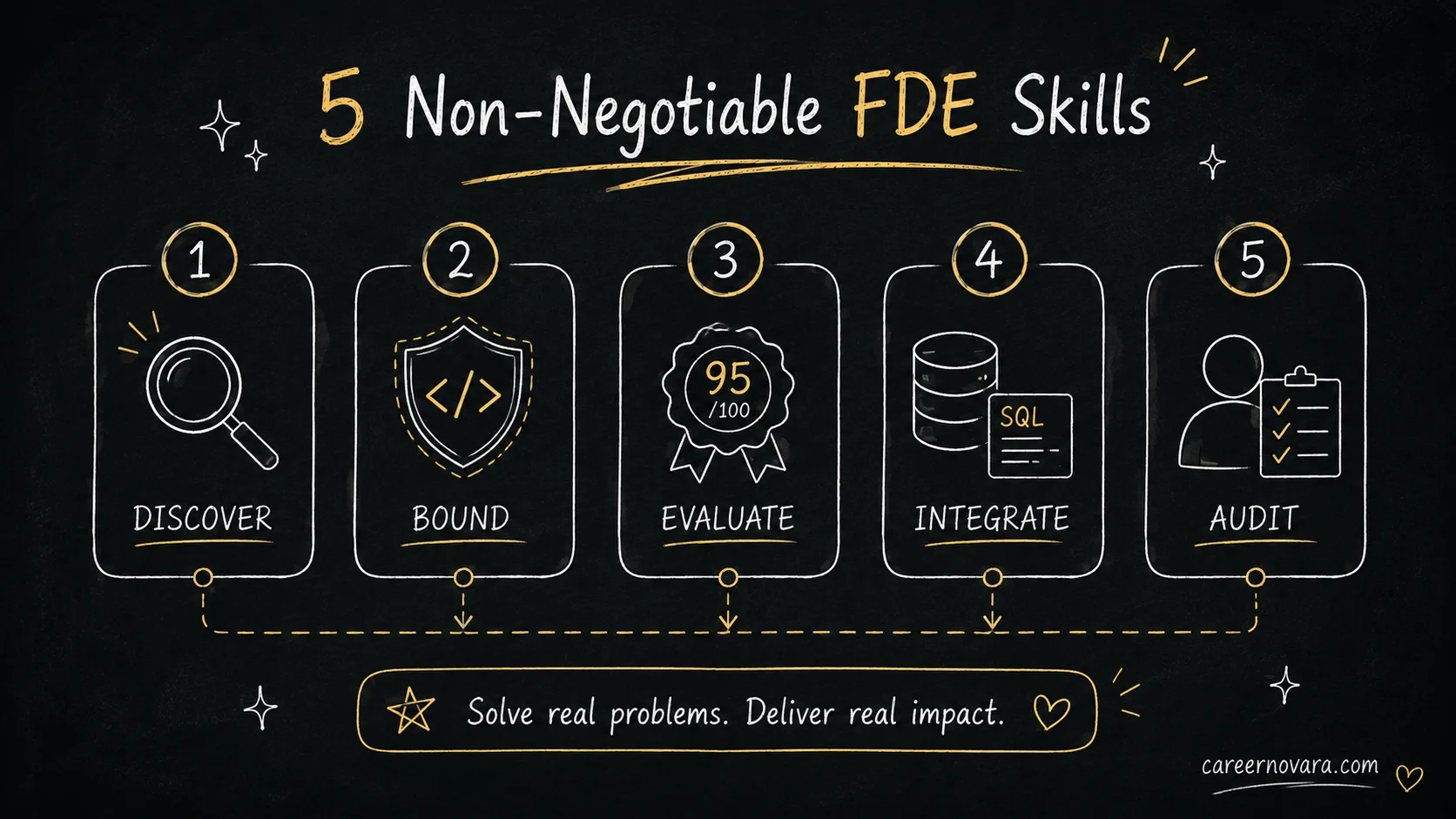
Key Takeaways
Instant Summary- Succeeding as a Forward Deployed Engineer requires moving beyond simple prompt generation into enterprise systems integration.
- The five essential FDE capabilities include Customer Discovery, Bounded AI Architecture, Eval Engineering, Legacy System Integration, and Auditability.
- Engineers who master both field communication and deterministic code boundaries command the top tier of AI hiring demand.
As enterprise adoption of Artificial Intelligence accelerates, the demand for Forward Deployed Engineers (FDEs) has skyrocketed. Modern companies like Palantir, OpenAI, Scale AI, and major technology consultancies are competing for engineers who can operate effectively at client sites.
(In my experience managing engineering deployments across global companies, I saw many brilliant coders fail in field roles. They could write complex algorithms in isolation, but they struggled when dropped into a messy customer meeting with incomplete data and legacy systems.)
Becoming a successful FDE requires a specific blend of customer communication, architectural discipline, and practical AI execution. Industry research published on TechCrunch and KDnuggets confirms that top AI labs prioritize field adaptability over theoretical computer science degrees.
Here are the 5 non-negotiable skills you must master to excel in a forward deployed engineer skills hiring loop and thrive in customer-facing deployments.
1. Customer Discovery and Problem Framing
The most critical skill for a Forward Deployed Engineer is turning ambiguous client requests into crisp technical requirements. Clients rarely explain their problems in clean technical terms. They complain about slow workflows, high operational costs, or missing data.
As an FDE, you must sit with business users, observe their daily routines, and ask probing questions to uncover the real root cause before writing a single line of code.
(I often tell developers that client discovery is simply diagnostic work. If you jump straight into building software without understanding the client’s actual workflow, you will build an impressive system that nobody uses.)
- Key Action: Learn to map business workflows into data inputs, processing steps, and expected outputs before selecting AI tools.
Never start with the technology stack. Start with the customer's operational bottleneck and work backward to the simplest technical solution.
2. Bounded AI Architecture (Deterministic Rules vs. Probabilistic AI)
A common mistake made by junior developers is attempting to build one massive AI agent that handles everything from invoice calculations to database updates.
Large Language Models (LLMs) are probabilistic, meaning their outputs contain natural variations. Critical business logic, accounting math, and security authorization checks must stay in deterministic, standard code.
(If your AI application miscalculates a customer’s invoice or hallucinates credit terms, the client will shut down the project immediately. Keep math in standard code and use AI strictly for unstructured text parsing.)
- Deterministic Bounds: Hardcode calculations, database validations, and security permissions in Python or TypeScript.
- Probabilistic Components: Reserve LLMs for summarizing text, classifying emails, or extracting JSON entities from messy documents.
3. Eval Engineering and Quality Benchmarking
In traditional software, code passes unit tests or fails. In AI development, model outputs can vary based on prompt phrasing, temperature settings, and model updates.
Forward Deployed Engineers excel at Eval Engineering. This means building automated evaluation benchmarks to measure model accuracy, latency, per-query cost, and hallucination rates across real client datasets.
(When presenting an AI solution to a risk-averse enterprise client, showing them a verified 98 percent accuracy score on a test set of 500 historical invoices builds immediate trust.)
- Key Frameworks: Master evaluation concepts using tools like Ragas, DeepEval, or custom benchmark scripts.
Enterprise clients demand proof, not promises. Building automated evaluation pipelines gives enterprise executives the confidence to deploy your AI application to production.
4. Legacy Systems Integration and Data Residency
Enterprise clients do not operate in a vacuum. They run legacy SQL databases, custom ERP tools, and strict local network firewalls.
An FDE must feel comfortable working with REST APIs, SQL databases, Docker containers, and hybrid cloud hosting environments. You must ensure that client data remains secure and compliant with data residency regulations.
(The most impressive AI model is useless if it cannot read data from the client’s internal SQL database or if it violates their corporate security policy.)
- Core Skills: Master REST API design, Docker containerization, and basic SQL query optimization.
5. Auditability and Human-in-the-Loop Workflow Design
No enterprise client will allow an AI system to execute high-risk decisions completely unsupervised. Forward Deployed Engineers design audit trails and human approval checkpoints directly into software workflows.
If an AI confidence score falls below a set threshold, the system automatically routes the task to a human manager for review.
(Designing clear human override buttons into an AI workflow turns a high-risk project into a safe, comfortable operational upgrade for enterprise management.)
Summary of the FDE Skill Matrix
To track your technical growth across these five core pillars, use this assessment framework:
| FDE Skill Pillar | Beginner Baseline | Production FDE Mastery | Business Value Created |
|---|---|---|---|
| Customer Discovery | Takes static requirements | Uncovers root operational bottlenecks | Prevents building wrong features |
| Bounded Architecture | Uses single mega-prompt bot | Separates hard code from LLM parsing | Eliminates invoice & math errors |
| Eval Engineering | Manual visual prompt check | Automated accuracy & cost benchmarks | Provides enterprise deployment proof |
| Systems Integration | Standalone API scripts | Dockerized legacy SQL & Cloud integration | Ensures security & data compliance |
| Auditability Design | Unsupervised bot execution | Confidence scores & human override UI | Builds executive operational trust |
Summary and Next Steps
Mastering these five skills transforms you from a traditional developer into a high-demand Forward Deployed Engineer capable of delivering enterprise business impact.
(Focus on mastering one skill pillar at a time. Start by taking an existing project and adding an automated evaluation script to benchmark its accuracy.)
Elevate Your Career with CareerNovara
At CareerNovara, we provide practical training and 1:1 mentorship for engineers, product managers, and working professionals:
- 1:1 AI Career Coaching: Get customized prompt engineering tools and resume positioning guidance at /coaching.
- AI Productivity Bootcamp: Master zero-coding workplace AI tools in our 11-day cohort at /bootcamp.
- 1:1 Strategic Mentorship: Work 1:1 with Yahya Bandukwala to architect your career transition at /mentorship.
- Chat on WhatsApp to discuss 1:1 career coaching.
Benchmark Your Forward Deployed Engineer Readiness
Taking your next career leap into AI & Field Engineering? Evaluate your 3-pillar capabilities across business strategy, system bounds, and execution in 5 minutes.