
5 Free Practical Resources to Learn Modern AI and LLMs (Without Expensive Bootcamps)
 Yahya Bandukwala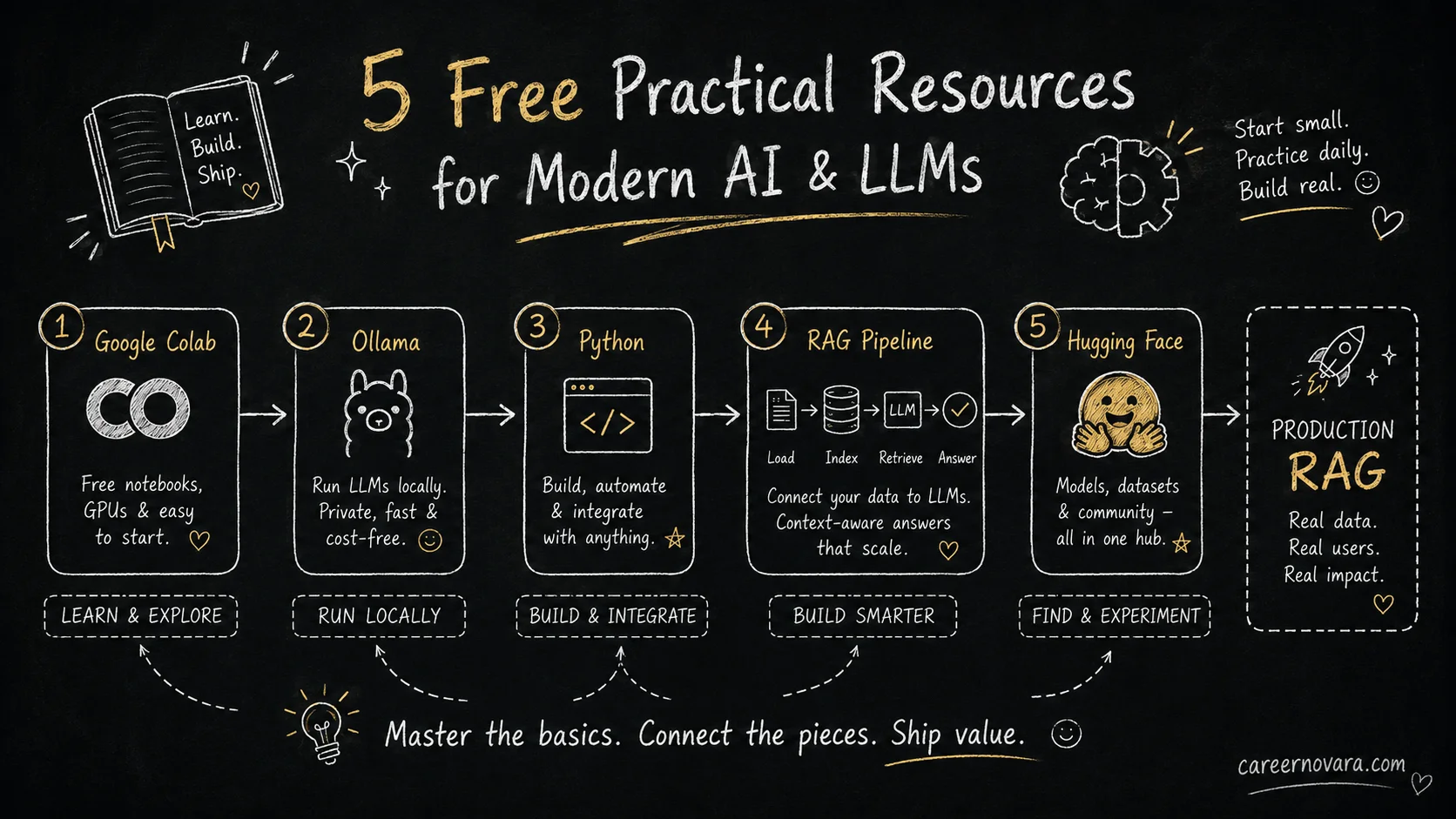
Key Takeaways
Instant Summary- Learning modern AI and LLMs does not require spending thousands of dollars on expensive bootcamps.
- The secret is matching your learning resource to your specific workplace goal, whether daily productivity, AI app building, or RAG architecture.
- Practical hands-on building on free platforms like Kaggle and Google Colab beats passive video watching every single time.
When professionals and engineers ask me how to get started with Artificial Intelligence, the first concern is almost always budget. Many assume that mastering modern AI requires paying thousands of dollars for heavy university degrees or sponsored certificates.
(In my own career leading large technology teams across global companies, I watched brilliant engineers stall their growth simply because they thought learning required a formal budget code or an expensive corporate sponsorship. That assumption is no longer true.)
The reality is that modern AI development is fundamentally open source. High quality learning roadmaps covering Large Language Models (LLMs), Retrieval-Augmented Generation (RAG), AI agents, and prompt engineering are completely free online.
According to technical learning reports on KDnuggets and DataCamp, the biggest challenge is not finding resources, but selecting the right starting point for your specific career stage.
Here are 5 battle-tested, free resources that teach practical modern AI without unnecessary academic fluff.
1. Introduction to AI for Work (DataCamp)
If you are a non-technical professional, manager, or career switcher, this short course on DataCamp is the ideal starting point. It requires zero coding background and takes under 3 hours to complete.
Rather than diving into neural network calculus, it focuses directly on practical workplace application: how generative AI automates routine tasks, accelerates research, and improves decision making.
(I often remind mentees who feel intimidated by tech jargon that understanding how to frame business problems for AI is far more valuable than memorizing model parameters.)
- Access Course: DataCamp Introduction to AI for Work
- Best For: Managers, analysts, and non-technical professionals.
- Key Focus: Workplace productivity, prompt logic, and AI risk awareness.
Start with workplace utility before technical complexity. Understanding how AI assists daily workflow saves immediate hours without writing a single line of code.
2. Easy-Vibe AI Coding Guide from Scratch
For product builders, founders, and early-stage developers who want to move from idea to working software prototype rapidly, the open-source Easy-Vibe AI Coding Guide focuses on building with AI assistants.
It bypasses traditional computer science prerequisites and introduces modern “vibe coding” workflows. You learn how to prompt AI tools like Claude Code and GitHub Copilot to generate frontend UIs, handle backend APIs, and connect databases.
(When managing fast-paced engineering rollouts, the fastest way to validate an architectural idea was always a quick working prototype rather than a 50-page specification document.)
- Access Course: Easy-Vibe AI Coding Guide
- Best For: Product managers, creators, and developers seeking rapid prototyping.
- Key Focus: AI-assisted development, frontend integration, and simple database deployment.
3. LLM Course by Maxime Labonne (GitHub Roadmap)
For software developers and data engineers who want a structured technical path into LLM internals, Maxime Labonne’s LLM Course on GitHub is one of the most respected roadmaps available.
It breaks learning into three distinct tracks: Fundamentals (Python and math foundations), LLM Scientist (model fine-tuning and quantization), and LLM Engineer (production application deployment).
(In my experience mentoring senior developers, the transition to AI engineering becomes smooth once you realize LLMs are system components that require strict integration rules, error handling, and API discipline.)
- Access Course: Maxime Labonne LLM Course on GitHub
- Best For: Software engineers and data professionals wanting a technical deep-dive.
- Key Focus: Fine-tuning, quantization, model evaluation, and deployment architecture.
Treat LLMs as software components within a broader architecture. Real engineering requires auditability, error handling, and hard boundaries around model outputs.
4. LLM Zoomcamp (DataTalks.Club)
If your goal is to build enterprise-grade search and retrieval systems, the free LLM Zoomcamp by DataTalks.Club offers a comprehensive 10-week hands-on curriculum.
It guides you step-by-step through building a production-ready AI knowledge assistant. You will master vector databases, embeddings, Retrieval-Augmented Generation (RAG), evaluation frameworks, and feedback loops.
- Access Course: DataTalks.Club LLM Zoomcamp
- Best For: Engineers building enterprise search engines and knowledge management tools.
- Key Focus: RAG architecture, vector search, hybrid retrieval, and monitoring.
5. Hugging Face LLM Course
Hugging Face is the center of the open-source AI ecosystem. The official Hugging Face LLM Course teaches you how to work directly with pretrained open models using Python, Transformers, and Tokenizers.
You learn how to fine-tune open-source models on custom datasets, optimize inference performance, and publish web demonstrations using Hugging Face Spaces.
(Working with open-source models gives you complete data privacy and cost control, which is essential for enterprise security compliance.)
- Access Course: Hugging Face LLM Course
- Best For: Developers looking to master open-source model fine-tuning and deployment.
- Key Focus: Transformers library, custom fine-tuning, datasets, and open model hubs.
Choosing Your Practical AI Roadmap
To help you decide where to invest your time, this comparative matrix aligns each resource with career objectives:
| Learning Resource | Target Audience | Core Skill Outcome | Prerequisites |
|---|---|---|---|
| DataCamp AI for Work | Managers & Professionals | Daily Workplace Productivity | None |
| Easy-Vibe AI Coding | Product Builders & Creators | Rapid AI App Prototyping | Basic Web Literacy |
| Maxime Labonne LLM Roadmap | Software Engineers | Comprehensive LLM Systems | Python & Math Basics |
| LLM Zoomcamp | Data & Backend Engineers | Production RAG & Vector Search | Intermediate Python |
| Hugging Face LLM Course | AI Developers | Open Model Fine-Tuning | Python & Deep Learning |
Summary and Next Steps
Learning modern AI is no longer gated by expensive tuition. Free cloud compute environments like Google Colab and Kaggle provide all the GPU power needed to run exercises and build your first project.
(Whenever I review career progress with engineers, the defining factor is never how many videos they watched, but whether they built something real and deployed it to users.)
Pick the single course above that matches your immediate goal, open a code editor or notebook, and build a working prototype today.
Elevate Your Career with CareerNovara
At CareerNovara, we provide practical training and 1:1 mentorship for engineers, product managers, and working professionals:
- 1:1 AI Career Coaching: Get customized prompt engineering tools and resume positioning guidance at /coaching.
- AI Productivity Bootcamp: Master zero-coding workplace AI tools in our 11-day cohort at /bootcamp.
- 1:1 Strategic Mentorship: Work 1:1 with Yahya Bandukwala to architect your career transition at /mentorship.
- Chat on WhatsApp to discuss 1:1 career coaching.
Benchmark Your Forward Deployed Engineer Readiness
Taking your next career leap into AI & Field Engineering? Evaluate your 3-pillar capabilities across business strategy, system bounds, and execution in 5 minutes.