

Forward Deployed Engineer vs. Solution Architect vs. Technical PM: Which Role Is Right for You?
 Yahya Bandukwala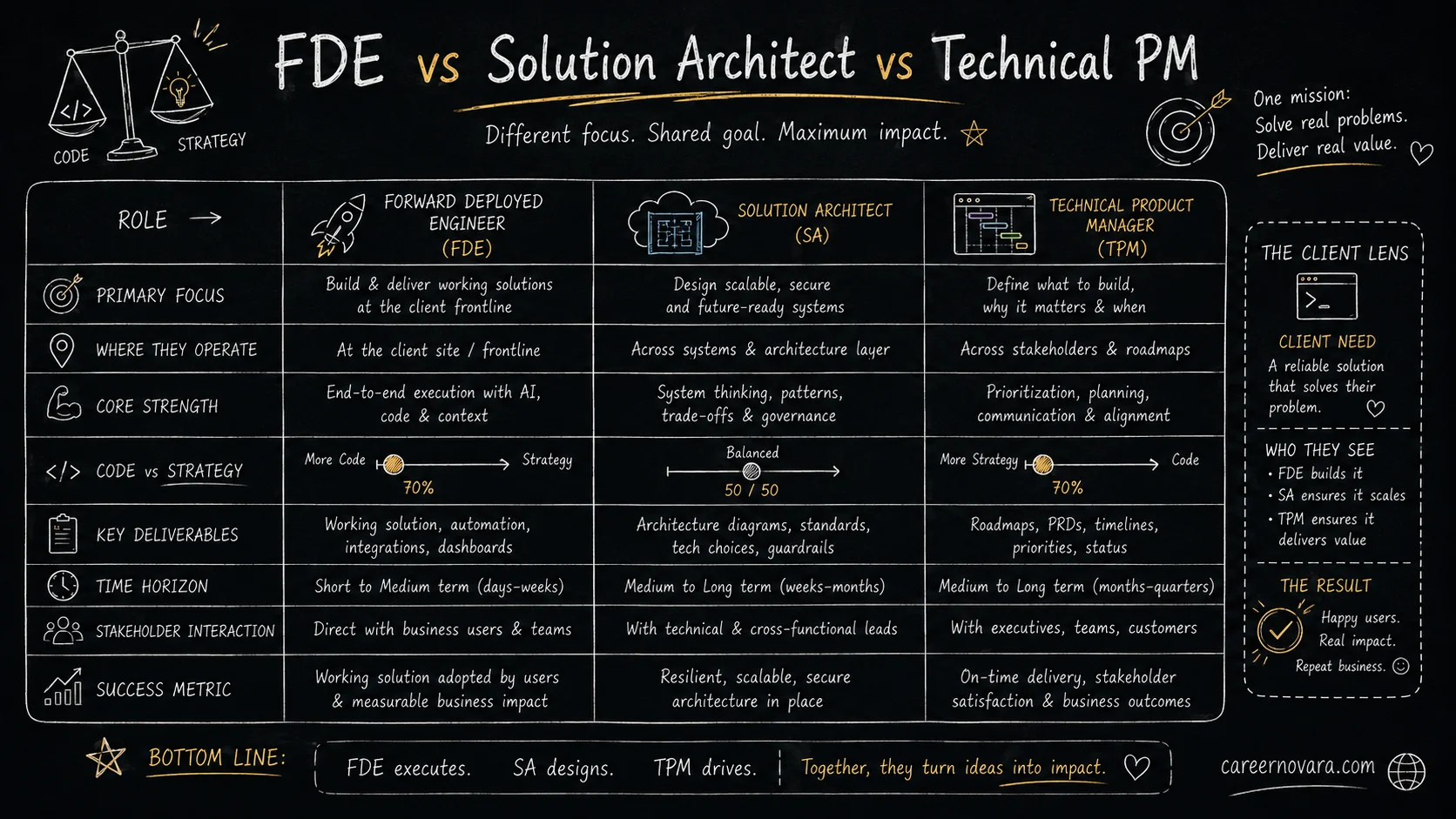
Key Takeaways
Instant Summary- The tech industry is witnessing significant title overlap between Forward Deployed Engineers, Solution Architects, and Technical Program Managers.
- Solution Architects focus on high-level system blueprints, Technical PMs own cross-team execution roadmaps, and Forward Deployed Engineers build and ship live software at client sites.
- Forward Deployed Engineers command higher compensation and equity ceilings because they bridge technical coding with direct customer revenue.
If you have been browsing tech job boards recently, you have likely noticed that job titles in software and artificial intelligence are changing rapidly. Roles like Forward Deployed Engineer (FDE), Solution Architect, and Technical Program Manager (TPM) often seem to ask for similar skills.
(In my career overseeing large engineering organizations, I frequently saw talented professionals get stuck in their careers simply because they chose a title that did not match their personal working style. Some loved coding but were trapped in endless status meetings, while others loved customer strategy but were forced into isolated ticket queues.)
Understanding the key differences between a forward deployed engineer vs solution architect vs technical pm is essential if you want to make an intentional career move. Modern industry analysis on Forbes and TechCrunch shows that companies are restructuring technical titles around direct customer outcomes rather than internal department silos.
Here is a clear, non-confusing comparison of all three roles to help you choose the right path for your skills and career goals.
1. Solution Architect: The High-Level Blueprint Master
A Solution Architect focuses on enterprise system design, security compliance, and vendor evaluation. They spend their days designing high-level technical blueprints, establishing architectural standards, and selecting cloud infrastructure components.
Solution Architects rarely write production code on a daily basis. Instead, they produce architecture documents, data flow diagrams, and integration standards for internal development teams to follow.
(If you enjoy high-level technical problem solving, cloud governance, and evaluating enterprise software platforms without getting pulled into daily bug fixes, the Solution Architect role is a natural fit.)
- Primary Focus: System blueprints, platform scalability, governance, and vendor selection.
- Code vs. Strategy Split: 15 percent code prototypes, 85 percent system strategy and architecture.
- Key Stakeholders: Enterprise CTOs, Security Officers, and Internal Engineering Leads.
Solution Architects design the theoretical blueprint for an enterprise system, but they rarely stay behind to write production code or debug live client deployment issues.
2. Technical Program Manager (TPM): The Cross-Functional Execution Engine
A Technical Program Manager owns cross-team project delivery, release schedules, risk mitigation, and technical alignment. TPMs sit at the intersection of product strategy, engineering execution, and executive reporting.
Unlike traditional project managers who focus purely on timelines, a TPM possesses enough technical background to understand API dependencies, database migrations, and system architecture bottlenecks.
(The best TPMs I worked with were not taskmasters who chased Jira status updates. They were technical translators who resolved complex dependency arguments between backend, frontend, and infrastructure teams.)
- Primary Focus: Cross-functional delivery, technical dependency mapping, release management, and risk mitigation.
- Code vs. Strategy Split: 5 percent technical prototyping, 95 percent program management and team alignment.
- Key Stakeholders: Engineering Managers, Product Leads, and Executive Leadership.
3. Forward Deployed Engineer (FDE): The Embedded Hands-On Builder
A Forward Deployed Engineer combines the customer discovery skills of a consultant, the requirement framing of a product manager, and the hands-on building of a full-stack software engineer.
Pioneered by companies like Palantir and now adopted by OpenAI, Scale AI, and major enterprise consultancies, FDEs deploy directly to client environments. They take ambiguous customer pain points, write production-grade code, integrate legacy APIs, and ship live AI applications.
(While a Solution Architect draws the diagram and a TPM manages the schedule, the Forward Deployed Engineer sits at the client desk, writes the integration code, and turns the idea into a working production app.)
- Primary Focus: Direct customer deployment, rapid AI prototyping, system integration, and hands-on production coding.
- Code vs. Strategy Split: 60 percent production coding and integration, 40 percent customer discovery and problem scoping.
- Key Stakeholders: Client Operations Leaders, Enterprise Business Users, and Core Product Engineers.
Forward Deployed Engineers are high-agency builders. They operate directly in front of the customer, writing code and shipping software where the business value is generated.
Comparing Core Dimensions Across All Three Roles
To help you evaluate which role aligns with your career background and salary expectations, review this comparative matrix:
| Evaluation Dimension | Solution Architect | Technical Program Manager (TPM) | Forward Deployed Engineer (FDE) |
|---|---|---|---|
| Primary Responsibility | Enterprise system blueprints & security | Cross-team release & dependency delivery | Client-facing production code & deployment |
| Daily Coding Requirement | Low (Proof-of-Concept scripts only) | Minimal to None | High (Daily production integration code) |
| Customer Interaction | Moderate (Executive & Security reviews) | Internal Focus (Cross-team alignment) | Extremely High (Embedded on-site or remote) |
| Ideal Career Background | Senior Systems/Cloud Engineers | Senior PMs, Scrum Masters, Tech Leads | Full-Stack Engineers, Tech PMs who code |
| Total Compensation Range | $180K – $280K (Base + Bonus) | $160K – $250K (Base + Equity) | $215K – $400K+ (High Equity / Frontier Lab tier) |
How to Choose Which Path Is Right for You
Making the right career choice comes down to assessing what work energizes you every day:
- Choose Solution Architect if you love high-level system design, enterprise security standards, and platform evaluation, but want to step away from daily coding tickets.
- Choose Technical Program Manager if you excel at organizing teams, mapping technical dependencies, and driving complex releases across large organizations.
- Choose Forward Deployed Engineer if you thrive on high-agency autonomy, enjoy solving customer problems directly, and want to write code that ships straight to production.
Summary and Next Steps
No single role is superior to the others. The key is choosing the path that matches your personal strengths and energy levels.
(If you are an engineer or technical manager who feels trapped behind bureaucratic approval layers, stepping into a Forward Deployed Engineer role gives you immediate impact and unmatched compensation upside.)
Elevate Your Career with CareerNovara
At CareerNovara, we provide practical training and 1:1 mentorship for engineers, product managers, and working professionals:
- 1:1 AI Career Coaching: Get customized prompt engineering tools and resume positioning guidance at /coaching.
- AI Productivity Bootcamp: Master zero-coding workplace AI tools in our 11-day cohort at /bootcamp.
- 1:1 Strategic Mentorship: Work 1:1 with Yahya Bandukwala to architect your career transition at /mentorship.
- Chat on WhatsApp to discuss 1:1 career coaching.
Benchmark Your Forward Deployed Engineer Readiness
Taking your next career leap into AI & Field Engineering? Evaluate your 3-pillar capabilities across business strategy, system bounds, and execution in 5 minutes.