

Beyond "Vibes Coding": The 6 Core Pillars Every AI Solution Architect Must Master
 Yahya Bandukwala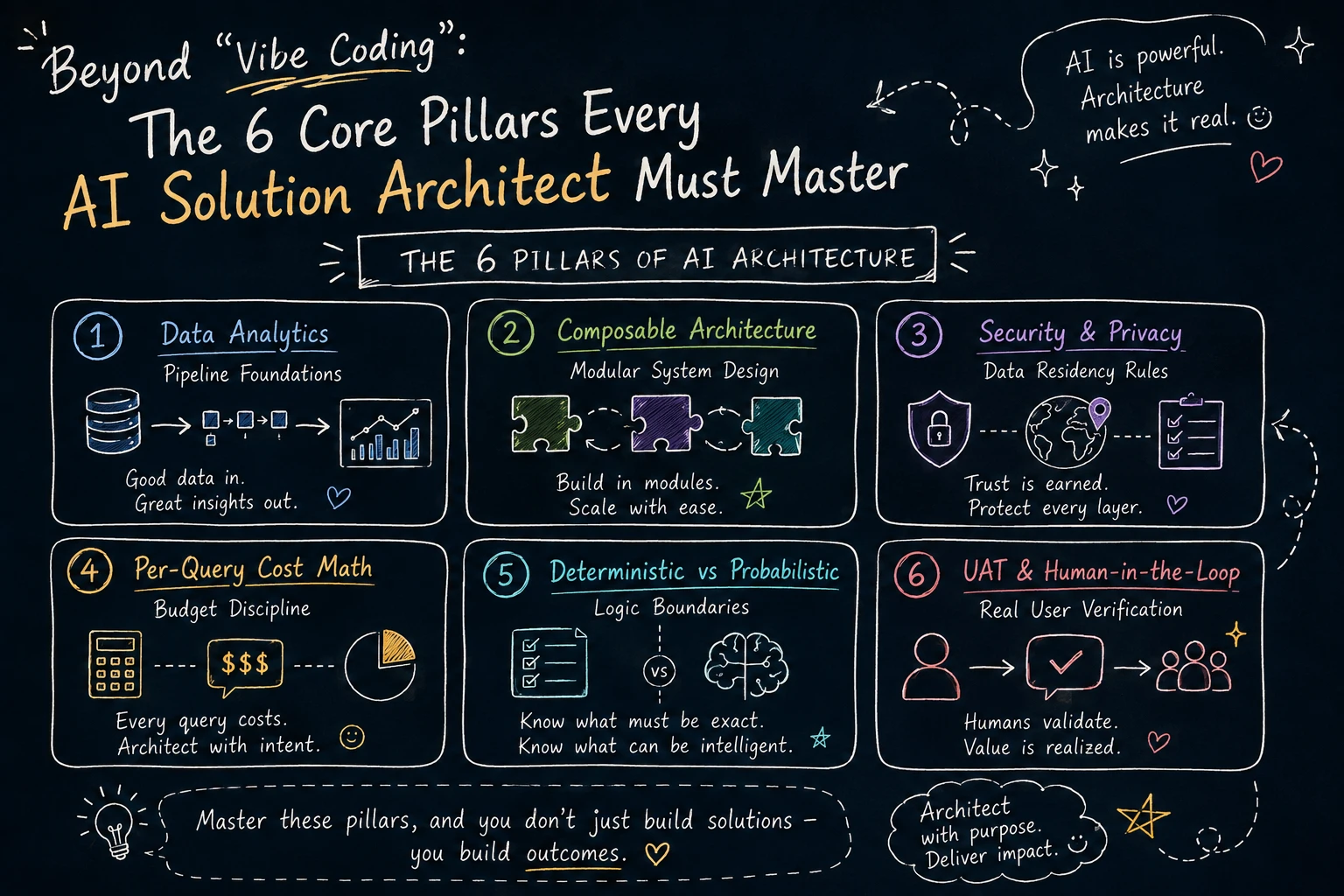
Key Takeaways
Instant Summary- Simple prompt engineering and one-liner code generation are not enough for real enterprise applications.
- Production AI requires 6 core pillars: Data Analytics, Composable Architecture, Security & Privacy, Cost Math, Deterministic Logic, and UAT.
- The Scaler FDE Judge framework proves that successful systems depend on clear requirement scoping and rigorous architecture defense.
In the modern software landscape, anyone can type a prompt into an AI tool and generate a basic script. Many engineers call this “vibes coding”.
While typing quick AI prompts works fine for simple side projects, it fails completely when you try to deploy a solution in a real business environment.
During the Scaler masterclass on Forward Deployed Engineering, one major truth stood out: enterprise companies do not pay for simple prompt wrappers. They pay for reliable, secure, and usable business architectures.
(It is easy to generate code. It is hard to make sure that code does not leak customer data or miscalculate credit limits. That is where real architecture comes in.)
Why “Vibes Coding” Fails in Production
When building AI solutions for real clients, you quickly run into challenges that simple code generators cannot solve:
- Unclear Requirements: Clients rarely ask for exact technical specs. They say things like “our support desk is slow” or “our inventory is messy”.
- Hallucinations & Bad Data: LLMs can confidently invent facts or cite wrong documents if they are not restricted by verification rules.
- Runaway API Costs: Unchecked LLM API calls can turn a simple feature into a massive monthly expense.
- Privacy & Security Violations: Sending confidential business data or customer PII to public APIs breaks enterprise privacy compliance.
To solve these problems, a Forward Deployed Engineer (FDE) must master six core foundational pillars.
Every production AI failure can usually be traced back to skipping at least one of these six pillars. Vibes coding skips all of them at once.
The 6 Pillars of a Modern AI Solution Architect
| THE 6 PILLARS OF AI ARCHITECTURE | ||
|---|---|---|
| 1. Data Analytics Pipeline Foundations |
2. Composable Architecture Modular System Design |
3. Security & Privacy Data Residency Rules |
| 4. Per-Query Cost Math Budget Discipline |
5. Deterministic vs Probabilistic Logic Boundaries |
6. UAT & Human-in-the-Loop Real User Verification |
1. Data Analytics & Pipeline Foundations
Before writing any AI prompt, you must understand your data. Is it structured SQL data, uncleaned Excel sheets, or raw audio notes? You need to know how to clean, extract, and normalize data using reliable ETL tools before passing it to AI models.
2. Composable Architecture Design
Instead of relying on “one big AI agent”, real systems are built as modular pipelines. Each node in the pipeline does one specific job: input intake, retrieval, logic check, guardrail, and user notification.
3. Security, Privacy & Data Residency
Enterprise clients require strict data security. In India, financial and customer data often must stay within local data centers (such as AWS Bedrock ap-south-1). Public APIs that use customer data for model training are an instant compliance failure.
Sending sensitive client data to a public API endpoint to save costs is not a shortcut. It is a liability. Always confirm data residency requirements before designing any AI pipeline.
4. Per-Query Cost Math
A good solution architect calculates cost arithmetic upfront. For example, if a company receives 12,000 queries per year, every pipeline step must fit within a clear budget ceiling, keeping per-query cost under a defined threshold.
5. Deterministic vs. Probabilistic Logic
This is the most critical rule: Do not use LLMs for tasks that require exact rules.
- Deterministic tasks (credit limit calculations, GST math, inventory counts) must be handled by traditional code or SQL queries.
- Probabilistic tasks (parsing regional voice notes, deduplicating messy product names) are where LLMs belong.
6. User Acceptance Testing (UAT) & Human-in-the-Loop
An AI system must fit smoothly into how real people work. If confidence on an AI output is low, the pipeline must route the item to a human manager for approval rather than auto-dispatching wrong orders.
Lessons from the Scaler FDE Judge Platform
During the Scaler workshop, we explored the FDE Judge platform, a tool designed to train engineers through a 3-act framework:
- Act 1 · Clarify: Asking 5 to 7 sharp questions to turn vague stakeholder statements into strict, cited requirements.
- Act 2 · Architect: Building an end-to-end canvas pipeline with explicit node configurations, cost bounds, and security guardrails.
- Act 3 · Defend: Defending the system architecture against senior engineers who try to force bad technical shortcuts (such as putting an entire database into a single context window).
The FDE Judge platform teaches one clear lesson: the quality of your clarifying questions determines the quality of your solution. An engineer who asks sharp questions builds sharp systems.
This structured approach separates true AI solution architects from casual coders.
Continue Reading the Series
This article is Part 2 of my 3-part series on Forward Deployed Engineering and modern AI architecture:
- Part 1: The Fall of the Siloed Specialist: How AI Compression Is Forcing the Rise of the Forward Deployed Engineer
- Part 2 (Current): Beyond “Vibes Coding”: The 6 Core Pillars Every AI Architect Must Master
- Part 3: The Business Owner’s Blueprint: Building Usable, High-ROI AI Solutions for MSMEs and Enterprises
Elevate Your Career: 1:1 Mentorship & AI Bootcamps
Mastering these 6 pillars requires moving past basic online tutorials into hands-on system design practice and executive career positioning.
At CareerNovara, we provide structured 1:1 mentorship and practical upskilling bootcamps for software engineers, product managers, and technology leaders:
- 1:1 AI Career Coaching: Get customized prompt engineering tools and 1:1 resume & career positioning guidance at /coaching.
- AI for Awareness & Productivity Bootcamp: Join our hands-on 11-day cohort to master zero-coding workplace AI tools at /bootcamp.
- 1:1 Quarterly Strategic Mentorship: Work 1:1 with Yahya Bandukwala to architect your career transition and master enterprise AI leadership at /mentorship.
- Chat on WhatsApp to discuss personalized career coaching or upskilling for your team.