

How to Ace the FDE System Design and Customer Scenario Interview
 Yahya Bandukwala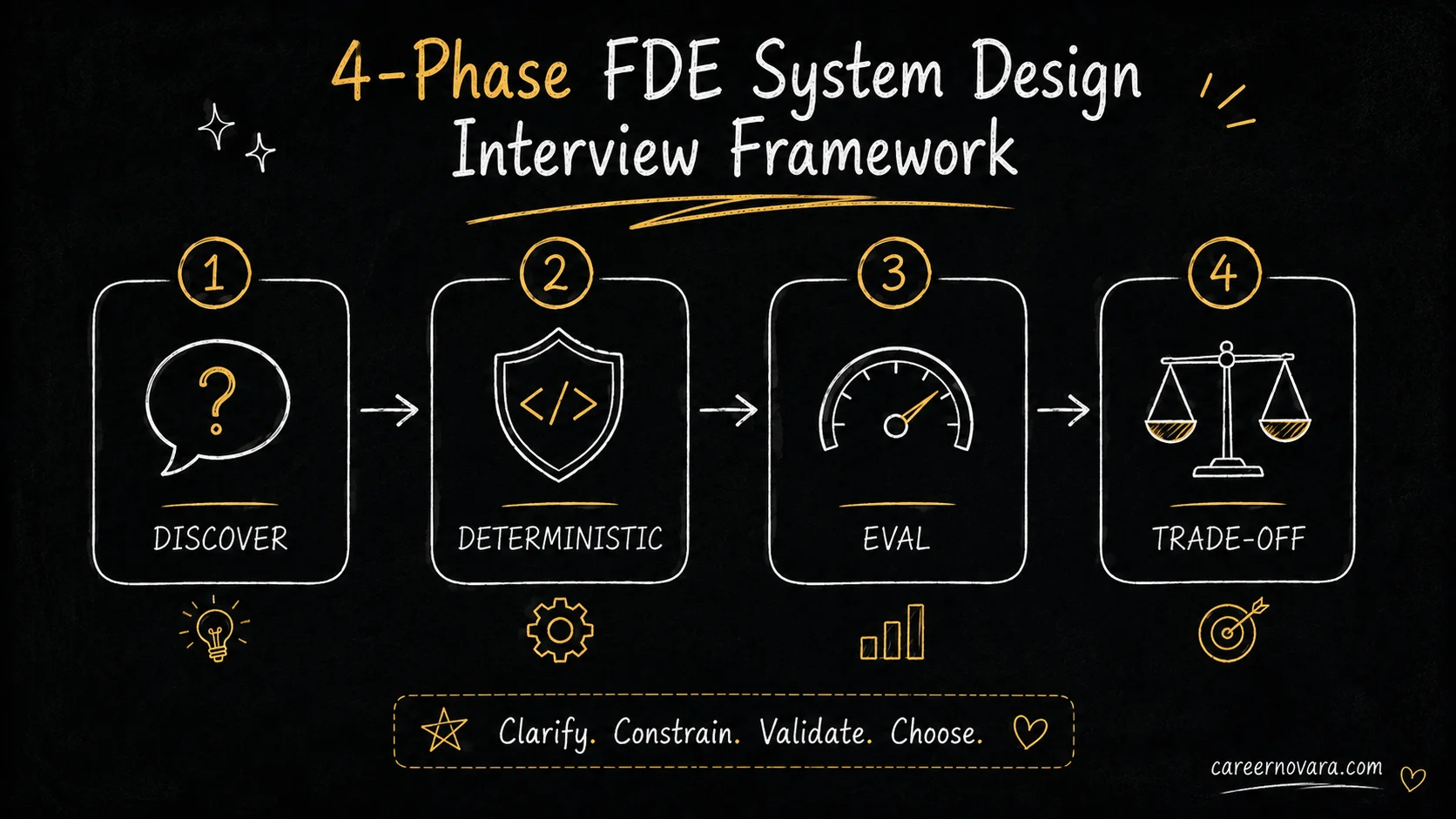
Key Takeaways
Instant Summary- Forward Deployed Engineer interviews test real-world problem framing, ambiguous customer discovery, and live architectural tradeoffs.
- Unlike traditional coding loops, FDE interviews evaluate how effectively you handle incomplete data, security constraints, and client pushback.
- Mastering the 4-phase FDE interview framework guarantees high scores across technical execution and communication rounds.
If you are applying for a Forward Deployed Engineer (FDE) role at companies like Palantir, OpenAI, Scale AI, or major enterprise AI consultancies, you will quickly notice that the interview process is very different from traditional software engineering loops.
(In my experience conducting technical hiring loops across engineering organizations, standard Data Structures and Algorithms tests rarely revealed who would succeed in front of clients. The candidates who excelled were those who could handle chaotic, incomplete customer requirements without panicking.)
An FDE interview evaluates both your technical depth and your field communication skills. Preparing for an FDE system design interview requires learning how to navigate client ambiguity, define system boundaries under pressure, and defend architectural tradeoffs.
Here is a practical, step-by-step framework to help you pass FDE hiring loops with confidence.
Why Traditional LeetCode Prep Is Not Enough
In a standard software developer interview, you are given a clean problem statement with clear inputs and expected outputs. In an FDE scenario interview, the interviewer intentionally gives you a vague, messy customer complaint.
For example, the interviewer might say: “Our logistics client has 500 managers sending unstructured PDF invoices over email, and their manual accounting processing takes 10 days. Design an AI deployment.”
Notice what is missing: no mention of database types, no API schemas, and no server constraints. The interviewer wants to test whether you jump straight to writing code or step back to ask diagnostic questions.
Never start drawing architecture diagrams immediately. In an FDE interview, spending the first 10 minutes asking clarifying discovery questions is the mark of a senior engineer.
The 4-Phase FDE Scenario Interview Framework
To structure your response clearly during live system design and customer scenario rounds, follow this 4-phase framework:
Phase 1: Clarify and Frame the Customer Problem (10 Minutes)
- Ask clarifying questions about user volume, data security policies, budget limits, and legacy system APIs.
- Identify whether the customer requires on-premise data residency or can use public cloud APIs.
- Define what success looks like (e.g., reducing processing time from 10 days to 2 hours with 98% accuracy).
Phase 2: Define Deterministic vs. Probabilistic Architecture (15 Minutes)
- Draw the high-level system diagram separating standard code rules from AI models.
- State clearly which tasks stay in deterministic code (e.g., tax math, invoice totals, database auth) and which tasks use AI (e.g., OCR text extraction from PDFs).
- Explain how you will handle API rate limits, error logging, and fallback mechanisms.
Phase 3: Introduce Eval Engineering and Quality Gates (10 Minutes)
- Explain how you will test model accuracy before deploying to production.
- Detail your benchmark dataset structure, scoring metrics, and cost-per-query limits.
- Describe human-in-the-loop audit checkpoints for low-confidence AI predictions.
Phase 4: Defend Tradeoffs Under Interviewer Pushback (10 Minutes)
- Interviewers will intentionally challenge your choices (e.g., “What if the client refuses to share data with cloud APIs?” or “What if the budget is cut by 50%?”).
- Stay calm, explain your alternative trade-offs (such as switching from a proprietary model to a quantized open-source model running on local servers), and justify the operational impact.
Answering interviewer pushback with composed, logical trade-offs shows that you can represent the company professionally in high-stakes client meetings.
Common FDE Interview Scenarios and Recommended Responses
To help you prepare, review how to handle typical interview scenarios:
| Interview Scenario Trap | Common Weak Response | Winning FDE Response |
|---|---|---|
| Vague Requirements | Starts drawing an LLM architecture immediately. | Asks 5 diagnostic questions about volume, security, and legacy APIs first. |
| AI Accuracy Concerns | Promises 100% AI model accuracy. | Presents an automated Eval framework with human-in-the-loop fallback gates. |
| Data Security Pushback | Suggests sending client data to public LLMs. | Proposes self-hosted open models inside Docker containers behind local firewalls. |
| Budget Constraints | Recommends expensive frontier model APIs. | Calculates cost-per-query and suggests small specialized models for routine classification. |
Summary and Next Steps
Clearing an FDE interview is not about memorizing complex algorithms. It is about demonstrating calm problem framing, practical AI execution, and clear communication under pressure.
(Practice delivering your 4-phase framework out loud with a peer or mentor. Being able to explain complex technical tradeoffs simply is the fastest way to land top FDE offers.)
Elevate Your Career with CareerNovara
At CareerNovara, we provide practical training and 1:1 mentorship for engineers, product managers, and working professionals:
- 1:1 AI Career Coaching: Get customized prompt engineering tools and resume positioning guidance at /coaching.
- AI Productivity Bootcamp: Master zero-coding workplace AI tools in our 11-day cohort at /bootcamp.
- 1:1 Strategic Mentorship: Work 1:1 with Yahya Bandukwala to architect your career transition at /mentorship.
- Chat on WhatsApp to discuss 1:1 career coaching.
Benchmark Your Forward Deployed Engineer Readiness
Taking your next career leap into AI & Field Engineering? Evaluate your 3-pillar capabilities across business strategy, system bounds, and execution in 5 minutes.